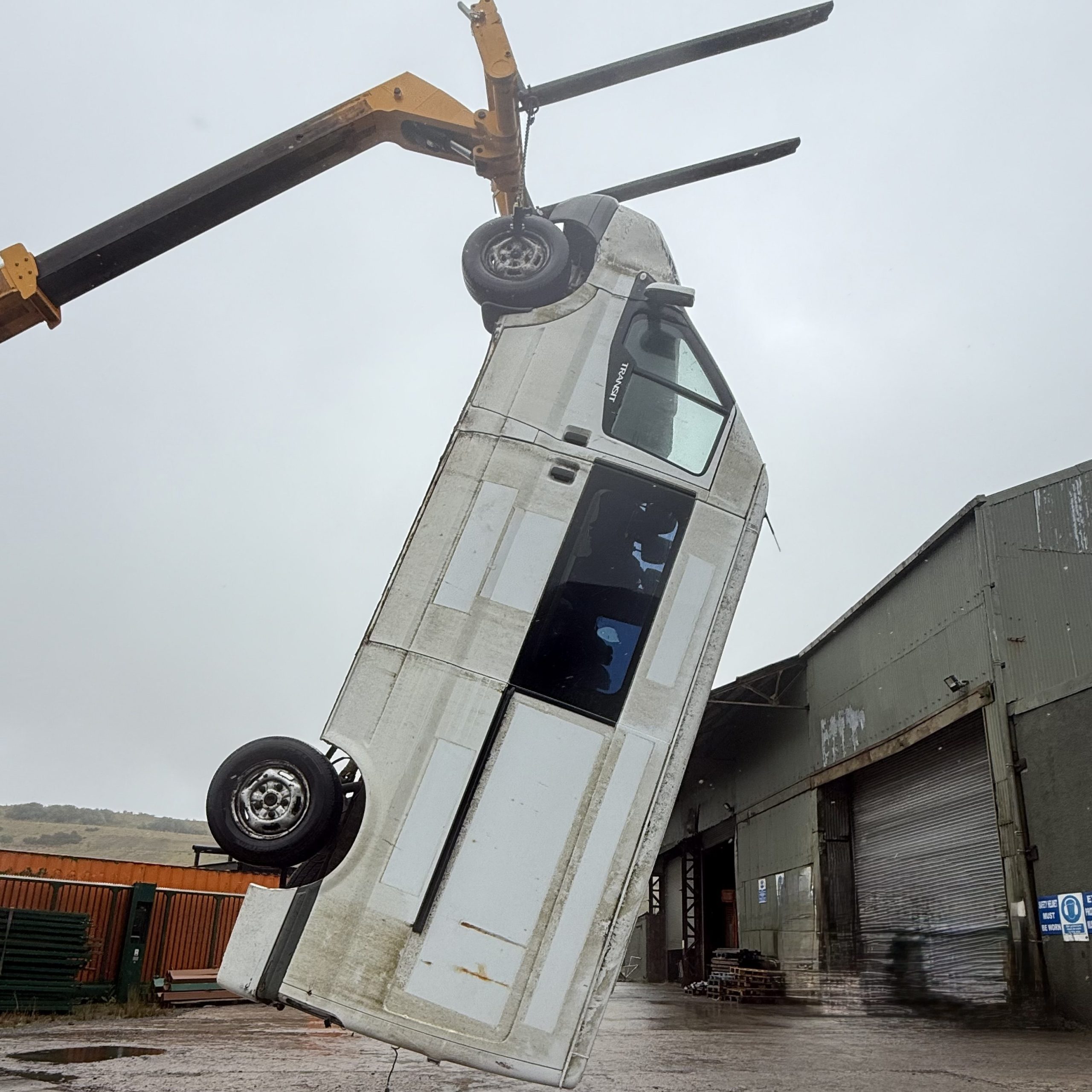
Special Projects has footage in its archive of a full-size van being lifted from the ground using NAU Snare.
There were no charges, no explosives and no energetic event. The lift was carried out using equipment designed for recovery work where blast is not an option.
The demonstration is simple to understand, which is why it works. A full-size vehicle gives immediate scale, and the result is clear without needing a long technical explanation. The target is lifted cleanly, the load is managed, and the surrounding area remains undisturbed.
That is the point of NAU Snare. It is not designed to create an event. It is designed to recover a target with control.
Why we ran the demonstration
Some capabilities are easier to show than explain.
When a tool is designed to lift and recover a significant mass without using an explosive charge, a written specification can only go so far. The van lift gives a clear visual reference for what NAU Snare can do.
The demonstration was set up to show that the system can lift a recognisable heavy target, that the lift can be carried out in a controlled way, and that recovery can be achieved without blast, fragmentation or an energetic input.
That matters in environments where the side-effects of a charge would create more problems than they solve.
How it was set up
A full-size van was used as the target because it gives people an immediate understanding of scale.
NAU Snare was deployed to lift the vehicle in a single controlled action. There were no charges, no pyrotechnics and no energetic components involved in the system.
The set-up, operation and tear-down followed documented procedures. The demonstration was treated in the same way Special Projects would approach a customer trial, with the process controlled, recorded and repeatable.
The van came off the ground cleanly. The lift held, and the load was managed throughout. There was no blast, no collateral damage.
Why non-explosive recovery matters
Many recovery tasks come with one major constraint: the operator cannot afford the effects of a charge.
Subsea, that may mean avoiding pressure pulses that disturb the seabed, affect marine life, or risk damage to nearby cables, wells and structures. Onshore, it may mean working in civil, industrial or populated environments where blast effects are unacceptable.
In sensitive environments, acoustic impact, regulation and environmental controls can rule out an energetic solution before the job has even started.
NAU Snare is built for those situations. The principle is straightforward: recover the target without creating avoidable damage around it.
Where NAU Snare applies
The van lift is an above-water demonstration, but the principle carries across to operational recovery work.
In subsea recovery, NAU Snare can be used to lift objects from the seabed without introducing blast effects into the environment.
In salvage operations, it provides a means to capture and lift target items as part of a broader recovery effort.
In sensitive environments, it supports work around marine protected areas, aquaculture sites, harbours, subsea infrastructure and other locations where pressure, acoustic impact or disturbance must be kept under control.
In civil and industrial recovery, it gives operators a non-explosive option where a controlled lift is required and the use of a charge is not acceptable.
Across these applications, the value is the same. NAU Snare gives operators more control, reduces collateral impact, and helps create a more predictable outcome.
Built, tested and documented
NAU Snare is designed in-house by Special Projects and supported by the company’s wider engineering and assurance processes.
This includes ISO 9001, 14001 and 45001 accreditation, documented standard operating procedures, internal R&D and test programmes, and a modular design approach that allows equipment to be configured around the requirement rather than forced into a fixed catalogue option.