Much of the conversation around ROV-led mine countermeasures focuses on detection. The sonar systems, the autonomous navigation, the ability to operate in near-zero visibility. These are genuine advances, and they matter.
But there is a step that receives less attention, and it is arguably the most consequential one: the moment the system physically engages with the device.
Everything before that point is preparation. What happens in those final few metres determines whether the disposal succeeds.
The problem with the final approach
Locating a mine is a solved problem in many operational environments. The harder challenge is attaching a disposal charge to a device that may be partially buried, sitting at an angle, obscured by sediment, or moving with the current. Doing that reliably, from a distance, without a diver, and in conditions that offer little margin for error, is where many systems fall short.
The consequences of a failed attachment are significant. The device remains live. The team must re-approach. Time, resource, and risk all increase.
What the Viper Mine Disposal System does differently
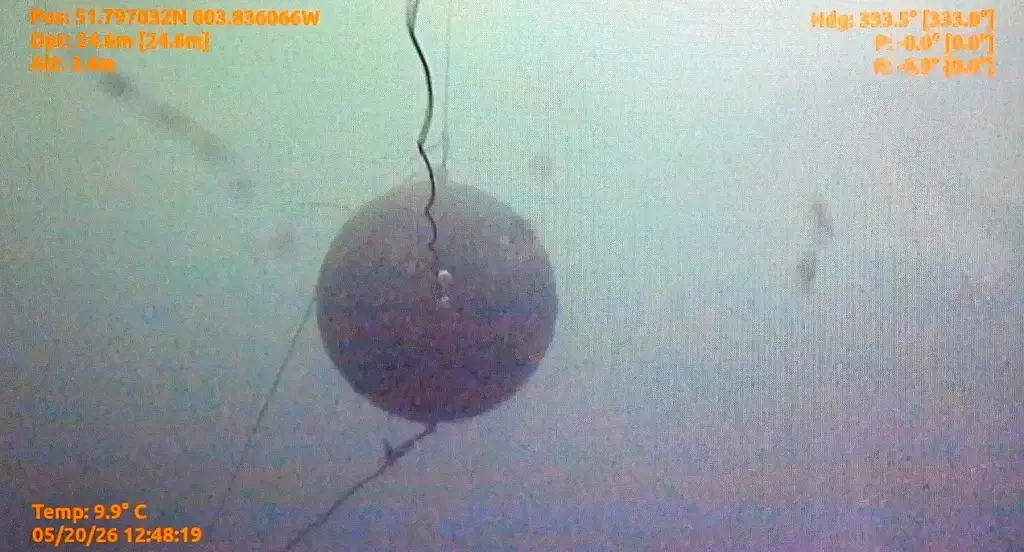
The Viper is designed to solve the attachment problem. Mounted to the front of the ROV, it uses a nail-gun mechanism to physically pierce the mine casing and lock on, creating a secure connection that holds even in current or against an irregular surface.
Once attached, the ROV withdraws and the shaped charge does its work, directing its blast energy inward with enough force to penetrate steel casing and initiate the main explosive fill. The operator remains on the surface throughout.
The result is a disposal sequence that is not dependent on ideal conditions, a perfectly presented target, or diver intervention as a fallback.
Why this matters now
The Royal Navy’s current deployment aboard RFA Lyme Bay, heading for a potential mine countermeasures mission in the Strait of Hormuz, puts systems like the Viper into sharp operational focus. The Gulf presents some of the most demanding underwater conditions for this kind of work: poor visibility, warm water affecting sonar performance, and pressure on speed of clearance.
In those environments, reliability of attachment is not a secondary consideration. It is the mission.
Across defence, port security, and offshore energy, the expectation of what an ROV-led disposal system should be capable of is rising. Systems that perform well on the range but struggle with real-world conditions are being replaced by those built for the hardest end of the task.
The Viper was built for that end.
If you are evaluating mine disposal capability or have an unexploded ordnance challenge that requires a dependable remote solution, we would welcome the conversation.